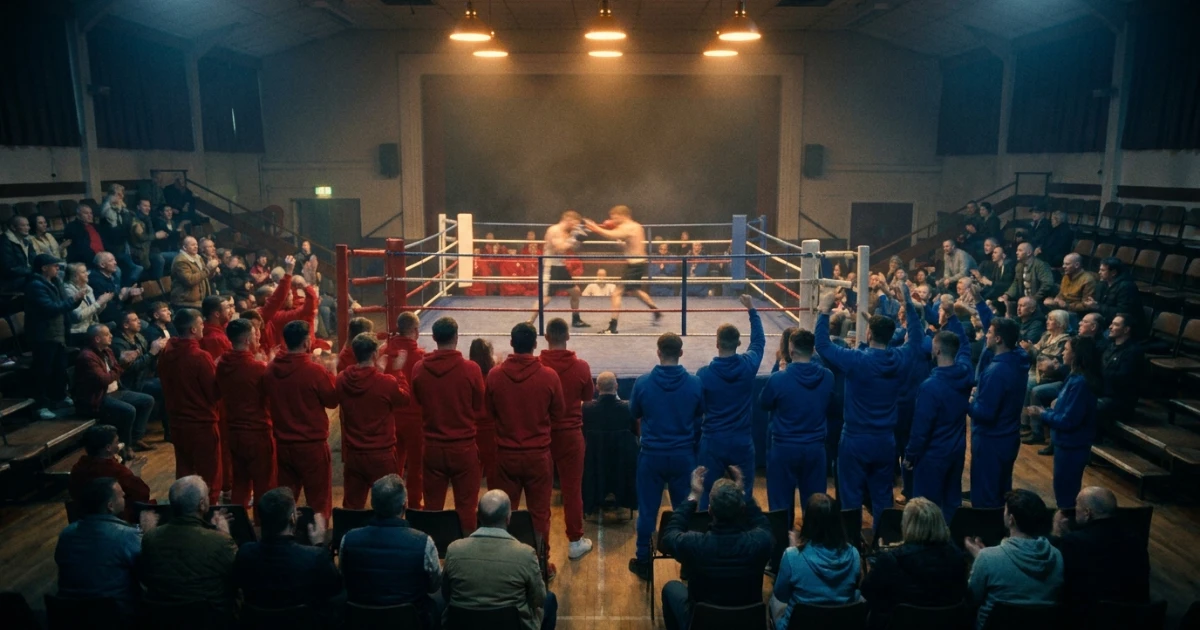
Walk into most amateur or semi-professional fight nights and you will quickly notice something: the crowd is almost entirely made up of fighters, their coaches and their immediate circle. Family, teammates, gym members. Not fans. Not the general public. Not people who decided to come along because they wanted an entertaining evening out.
This is not a new observation. Anyone who has spent time in the combat sports world has noticed it. A card with eight bouts and sixteen fighters in it might draw a hundred and twenty people — and if you asked each of those hundred and twenty people who they came to see, almost every one of them could give you a name. A specific name. A person they know.
The question is whether that is the ceiling, or whether it is just where promoters have learned to stop.
The 80% problem — and why it exists
The overwhelming majority of fight night attendees are people with a personal connection to someone competing. This is not a failure of marketing. It is a structural reality that reflects something quite simple: most people do not go to watch strangers fight.
Think about how you behave as a casual sports fan. You watch a Premier League match because you support a team, or because you know the players, or because a specific storyline has captured your interest. You watch a heavyweight title fight because the promoter and broadcaster have spent months building both fighters into characters — with histories, rivalries, personalities and stakes you understand.
Now think about the average local fight night poster. A date. A venue. A list of names. Perhaps a discipline. That is typically it.
If you have never heard of any of those names, you have no reason to care. You are being asked to pay money to go and watch strangers hit each other — strangers with no context, no story, no reason to root for either of them. The proposition makes no sense unless the evening itself is a compelling enough attraction on its own, which local fight nights rarely are when competing with pubs, cinemas, restaurants and home streaming.
The fighters and their circles come anyway because they have their own reason to be there: a personal stake. They do not need to be persuaded. The general public does.
What the UFC taught the world about casual fans
Before the UFC became the global business it is today, combat sports had the same problem at a much larger scale. Boxing had already worked out part of the solution — the build-up, the press conferences, the storyline — but early MMA struggled to cross over to mainstream audiences precisely because it was difficult to emotionally invest in a contest between two people you had never heard of.
What changed was not the sport. It was the storytelling. The Ultimate Fighter series in 2005 put fighters in front of cameras for weeks, showed their personalities, their backgrounds, their motivations and their conflicts. By the time the finale aired, casual viewers had a reason to care. They had chosen a side. The sport became something they were watching rather than something happening in front of them.
That lesson applies at every level of combat sports, including the local show at a leisure centre or a university sports hall. The mechanism is the same: give people a reason to care about who is fighting, and they will engage. Fail to give them a reason, and you are asking them to generate that interest on their own, which most people will not bother to do.
The story sells the seat
Consider what actually makes someone want to watch a fight. It is rarely the technical quality of the contest — most casual fans cannot reliably evaluate technical quality anyway, at least not until they have watched a lot of fights. What makes someone want to watch is usually one of three things: a fighter they find compelling, a narrative they are invested in, or an atmosphere that makes the experience enjoyable in itself.
For local promoters, the atmosphere part is largely fixed by the venue. But the first two — a compelling fighter and an investable narrative — are entirely within reach if you are willing to do the work of communicating them before the event.
What does that look like in practice? It means putting a face to a name. A photo that captures something about who this person is. A brief biography that explains where they come from, how long they have been competing, what this fight means to them. Their record, which tells a story in three numbers — how many times have they won, lost, drawn. And where possible, footage. A clip of them in a previous bout, or a training round, that gives someone watching from their phone a sense of what they are about to see.
None of this is complicated. It is exactly what sports journalists and boxing promoters have been doing for generations. The difference is that small combat sports promoters have traditionally lacked the tools to do it cleanly, at scale, and with the kind of shareable output that fits how audiences consume content today.
Shareable content is the modern version of the fight poster
The old fight poster worked because it reached people where they were — on noticeboards, lamp posts, in gym windows. Today people are where they are on their phones, on social media, in group chats. The fight poster still matters, but it is no longer sufficient on its own.
What travels in 2026 is a link. A link to a page that loads quickly, looks credible, tells the story and gives someone everything they need to decide whether to come. A link that works just as well when someone opens it on the bus as when they open it on a laptop. A link someone can forward to a friend with a one-line message — "you should come to this" — and have that friend actually click it and want to go.
For that link to do its job, the page it opens needs to contain real information about the fighters. Photos, so they can picture who they are going to watch. Records, so they understand the stakes — a fighter on a five-fight winning streak means something different from a prospect making their debut. A brief story, so there is something to talk about and share. And if possible, a clip — because nothing sells a fighter like watching them in action, even briefly.
When a promoter shares an event page that contains all of that, they are not just sharing a calendar entry. They are sharing a reason to come.
Practical steps for promoters who want to grow their crowd
Building an audience beyond fighters and their circles takes consistent effort, but it is not mysterious. These are the habits that make a difference over time.
Start building fighter profiles well before the event. Give yourself at least three to four weeks. Collect a good photo from each fighter — ideally a decent head shot or action photo rather than a cropped gym selfie. Ask them for two or three sentences about themselves and what this fight means to them. Get their record right. These are details fighters are usually happy to provide when they understand how it benefits them.
Use the fighters' own networks intentionally. Every fighter on your card has followers, friends and family who might come if they knew the event existed and if the material made it easy to share. Give fighters a link to their own spotlight — a page where their photo, record and bio are presented properly — and ask them to share it. A fighter sharing their own fight page is far more credible and engaging than a generic event announcement from a gym account.
Treat the event page as a storytelling tool, not just a logistics document. Dates, times and ticket prices matter — but they are not why someone who does not know any of the fighters decides to come. What makes them come is feeling like they know what they are going to get, and feeling like it is worth their time and money. Build the page with that audience in mind.
Leverage highlight clips wherever possible. Even a short clip of a previous bout — thirty seconds of action — makes a fighter feel real to someone who has never seen them fight. If you do not have footage of previous bouts, a short sparring clip, a training round or even a punching bag session can work. Something that shows what this fighter looks like in motion is always better than nothing.
Give people a reason to come back. If someone attends for the first time and has a good experience, they are far more likely to come to the next event — especially if they now have a fighter they followed from before. Build continuity into how you communicate. If a fighter wins convincingly, mention them when you announce the next card. If a rematch is brewing, tease it. Give casual fans the thing that makes them choose your next show over an alternative on the same night.
How Blue6 makes this achievable for any promoter
Historically, creating a genuinely well-presented public fight card required either a dedicated web developer or graphic designer, or a significant amount of manual work with tools not built for the purpose. Most local promoters do not have either.
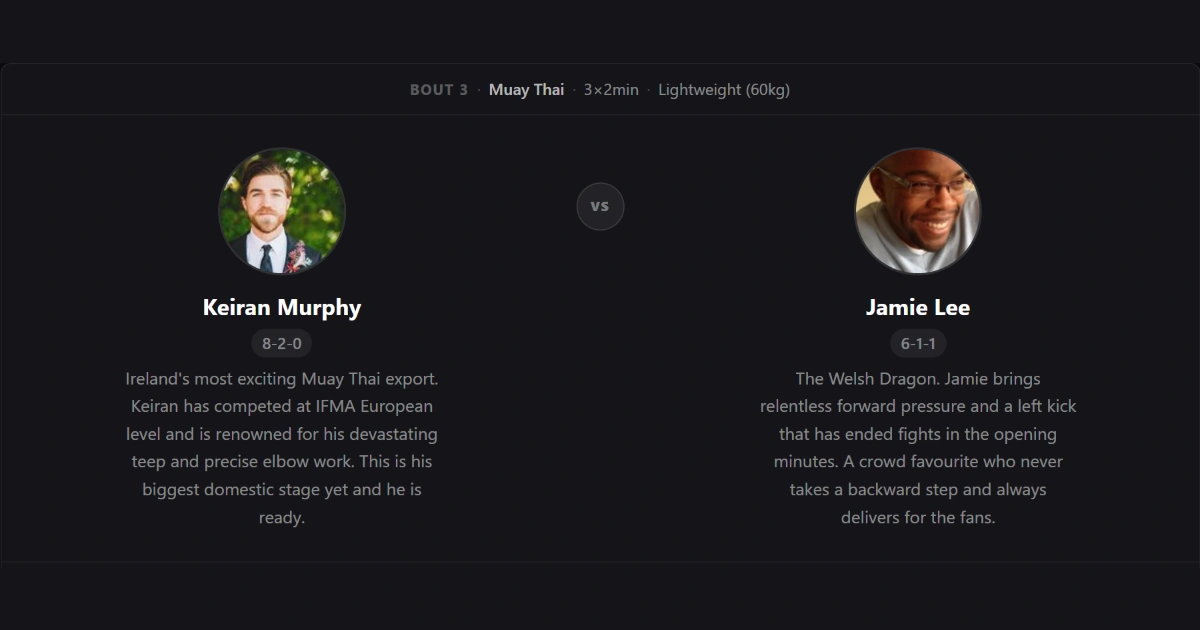
Blue6 now includes a fighter spotlight feature built directly into the event management dashboard. For each bout on your card, you can add a photo, record, biography and highlight video for both fighters. That information is then displayed on the public event page automatically — presented in a layout designed for sharing, optimised for mobile, and built to give casual audiences something worth clicking through to.
Adding a spotlight for a fighter takes a few minutes. You can upload a photo directly, paste a Cloudinary, YouTube or Vimeo link, pull in the fighter's existing record from their profile, and add a biography in their own words or yours. When you have added spotlight information to all of your bouts, what you have is not just an event listing but a proper fight card — one where someone who has never heard of any of the fighters can scroll through, read the stories, watch a clip or two and decide that this is worth going to.
That is the event page you share. That is the link fighters send to their followers. That is what you drop in the local Facebook group, the sports club WhatsApp and the university noticeboard. Not "fight night, Saturday, doors 7pm" — but a page that actually shows people what they are coming to see.
The fighters are already doing their part. They are training, competing and building their records. The question is whether the promotional infrastructure around them is doing its part — and for most local combat sports shows, there has historically been a significant gap.
The bigger picture
Combat sports have an audience problem that is partly a perception problem and partly an access problem. The perception problem — that fighting is niche, intimidating or only for hardcore fans — is harder to solve. The access problem — that casual fans simply do not know who is fighting or why it should matter to them — is very solvable, and it is where promoters can make a real difference.
A fight night where eighty percent of the crowd are fighters and their circles is not a failure. It is a starting point. The question is what you build from there. The gyms and promoters who figure out how to tell their fighters' stories before the event — consistently, clearly, and through channels where their potential audience actually is — are the ones who will grow from a hundred and twenty people in a leisure centre to two hundred, then three hundred, then more.
General public attendance does not happen by accident. It happens because someone made the effort to give strangers a reason to come. Start giving them that reason, and they will show up.
If you want to explore how Blue6 can help you run better events and build a more professional public fight card, visit blue6.uk/features or read the complete guide to running a fight night.